
Planners: 3 Operational Essentials for a VIP Transport Protocol
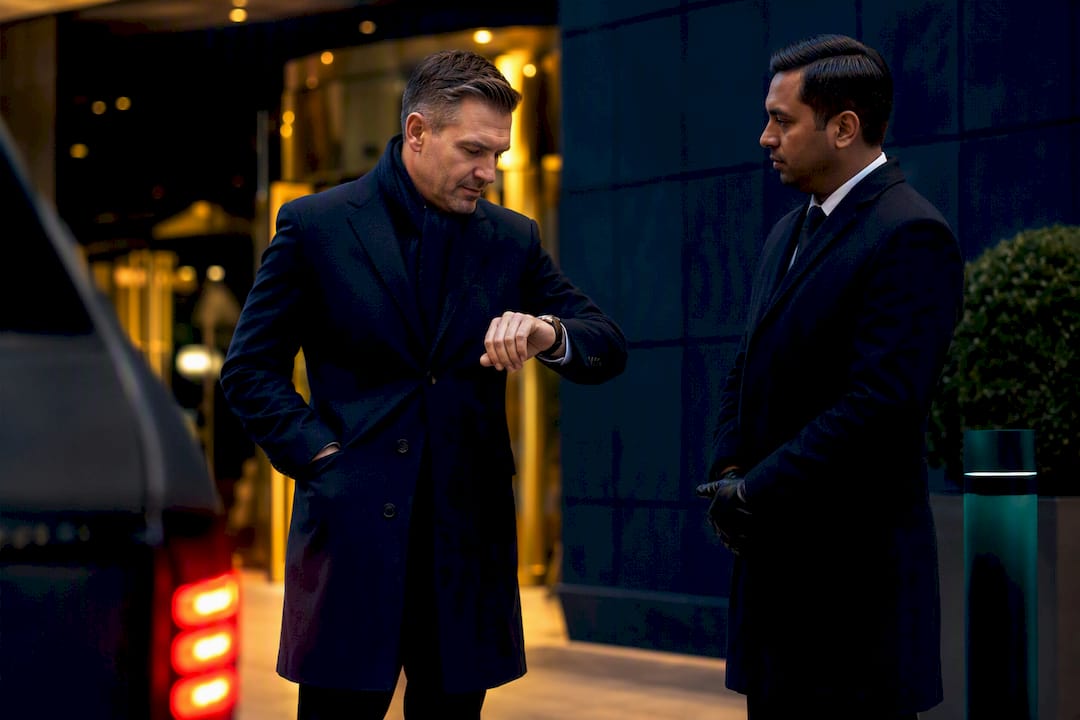
A VIP transport protocol has to deliver three things at once: safety, confidentiality and punctuality, and it does this through five working parts. Those parts are tiering (grading who you are moving and why it matters), pre-event planning, vetted and trained staff, secure route design, and controlled communications backed by a contingency plan. Standard operating procedures and restricted manifests sit underneath all five, limiting who sees what and cutting the exposure that causes most VIP transport failures.
TL;DR:
Proper tiering ensures high-risk VIPs receive full security teams, while lower-tier movements rely on trained chauffeurs and basic route planning.
Pre-event checklists and secure communication channels minimize timing errors and prevent information leaks, with strict access controls based on role necessity.
Route planning includes primary, alternate, and contingency options tested at the same time of day to counter unpredictable traffic and disruptions.
Vehicles are inspected thoroughly before every movement, with backup options staged nearby and equipment for emergencies always on hand.
Running tabletop exercises for mechanical and security scenarios helps teams identify gaps before executing high-stakes VIP transports.
Table of Contents
What is a VIP transport protocol?
A VIP transport protocol is the documented set of rules, roles and checkpoints that govern how a high-profile individual moves from one point to another safely, privately and on time. It is not a single document but a system: tiering rules that decide how much protection a movement needs, a planning checklist that runs from days out to minutes out, staffing standards for chauffeurs and coordinators, route and communications controls, and a response plan for when something goes wrong.
The phrase gets used loosely across the security and hospitality world, sometimes interchangeably with “VIP security protocol” or “executive protection plan.” Worth separating out immediately: this has nothing to do with the technical networking term VIP (Virtual IP), used in systems like VOLTTRON’s message bus for secure agent communications. If you are researching transport security and land on networking documentation, you are in the wrong domain.
Government protocol offices formalise much of this. Official protocol transport guidance trains chauffeurs in etiquette, first aid and defensive driving as standard, and treats liaison with protocol officers as a core, non-optional part of any dignitary movement. That same discipline scales down cleanly to corporate and executive transport, which is where most organisations reading this will actually apply it.
VIP tiering and operational roles
Not every VIP needs the same level of protection, and treating every movement identically wastes resources on low-risk trips while under-resourcing genuinely high-risk ones. A three-tier model solves this cleanly.
Tier one: principal. Heads of state, senior political figures, or executives under specific, known threat. These movements require a full team: security lead, advance reconnaissance, primary and alternate routes, and often liaison with police or protective services.
Tier two: senior. C-suite executives, visiting dignitaries without acute threat indicators, or high-net-worth clients. These need trained chauffeurs, route planning and restricted manifests, but rarely require armed escort or full advance teams.
Tier three: elevated. VIP guests at corporate events, wedding parties, or executives on routine but reputationally sensitive travel. Professional standards apply throughout, but the operational overhead is lighter.
Each tier maps to defined roles, and clarity here is what prevents confusion when something changes at short notice:
Host – the client or organisation commissioning the movement, responsible for final sign-off on itinerary changes.
Protocol lead – owns the overall plan, tiering decision and liaison with any official authorities involved.
Transport coordinator – manages vehicles, chauffeurs and timing, and is the single point of contact on the day.
Security lead – present for tier-one and higher-risk tier-two movements; owns route selection and threat assessment.
Advance team – scouts the route and destination ahead of the principal’s arrival, confirming access points and staging areas.
Restricted-manifest rules follow the tiering, too. A tier-one movement might limit full itinerary knowledge to three people; a tier-three movement can afford wider but still controlled distribution. The principle stays constant across tiers: each role receives only the information it needs to perform its task, which reduces both insider risk and accidental leaks.
Pre-event planning checklist and approvals
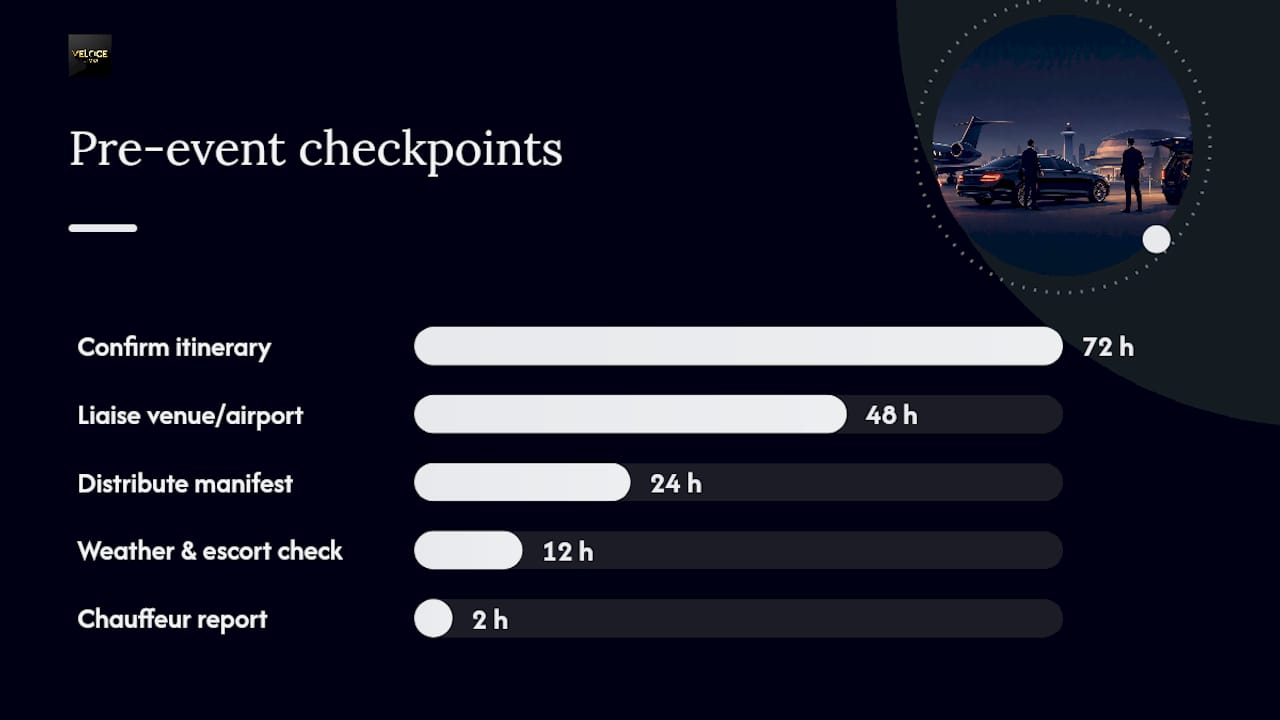
Planning failures cause more VIP transport incidents than security failures do. A missed venue permission, an unconfirmed flight change, or a chauffeur briefed on the wrong pickup point creates the kind of visible chaos a protocol exists to prevent. The fix is a checklist run against fixed time checkpoints, counting backwards from the movement itself.
T-72 hours: Confirm the full itinerary with the host and lock the vehicle type against the tiering decision. Verify venue or airport access requirements, including any accreditation the chauffeur or advance team will need.
T-48 hours: Liaise with venue security or airport ground staff to confirm arrival protocols, parking or staging permissions, and any restricted zones. Hotel VIP handling guidance recommends pre-arrival preparation and staff briefings at exactly this stage, and the same logic applies to any fixed destination, not just hotels.
T-24 hours: Distribute the restricted manifest to assigned staff only. Confirm chauffeur assignment, vehicle readiness and route plan with the transport coordinator.
T-12 hours: Run a final weather and traffic check against the planned route. Confirm any police liaison or official escort request has been acknowledged, if one applies to the tier.
T-2 hours: Chauffeur and vehicle report for pre-shift inspection. Advance team confirms staging area is clear and communications channels are live.
Documentation to gather across this window includes signed confirmations from the host, venue access passes, flight or event schedules, and a single-page briefing sheet for each chauffeur that contains only what their role requires. Event management guidance consistently points to dedicated arrival teams and rapid-response contact systems as what actually prevents timing failures on the day, rather than any amount of planning done without a live point of contact.
Pro Tip: Build a single shared timeline document that every role can see their own tasks on, but strip principal-specific detail from any version that reaches vehicle staff below the transport coordinator level. This keeps the manifest restricted without leaving anyone guessing what time they need to move.
Chauffeur vetting, training and conduct protocols
The chauffeur is the person spending the most uninterrupted time with the principal, which makes vetting and training here non-negotiable rather than a nice-to-have. Background checks should cover identity verification, employment history, a clean driving record check, and, for tier-one and sensitive tier-two work, a formal security clearance process where the jurisdiction supports one.
Training needs to go well beyond driving skill. Official protocol chauffeur programmes combine etiquette, first aid and specialist driving instruction as a single package, not separate optional modules, and that combination is what separates a protocol-trained chauffeur from a general private-hire driver. A chauffeur who can defensive-drive but cannot administer basic first aid, or who knows first aid but breaks radio discipline mid-movement, is only half-trained.
A working training and conduct list looks like this:
Etiquette and protocol conduct, including how to address a principal, when to speak, and appropriate physical distance.
First aid basics, refreshed annually, covering at minimum CPR and basic trauma response.
Radio and communications discipline: fixed call signs, no principal names over open channels, and clear escalation phrasing.
Route familiarisation and defensive driving specific to the vehicle class being used.
Confidentiality agreements signed before assignment, covering manifest details, photography and social media.
A sample briefing checklist for chauffeurs before any movement should confirm: vehicle inspected and fuelled, route loaded and alternates known, communications channel tested, escalation contact saved and confirmed reachable, and manifest details limited to pickup point, drop point and timing only. Escalation contacts need to be a named person, not a department, because a movement that stalls waiting for someone to pick up a general line has already failed the punctuality test.
Route planning, escorts and liaison with authorities
Route design is where most of the actual security work in a VIP transport protocol happens, and it starts with more than one option. A credible route planning framework recommends at least one primary route and two alternates for any tier-two-or-above movement, each scored against traffic predictability, choke points, and how easily a route can be changed mid-journey if something looks wrong.
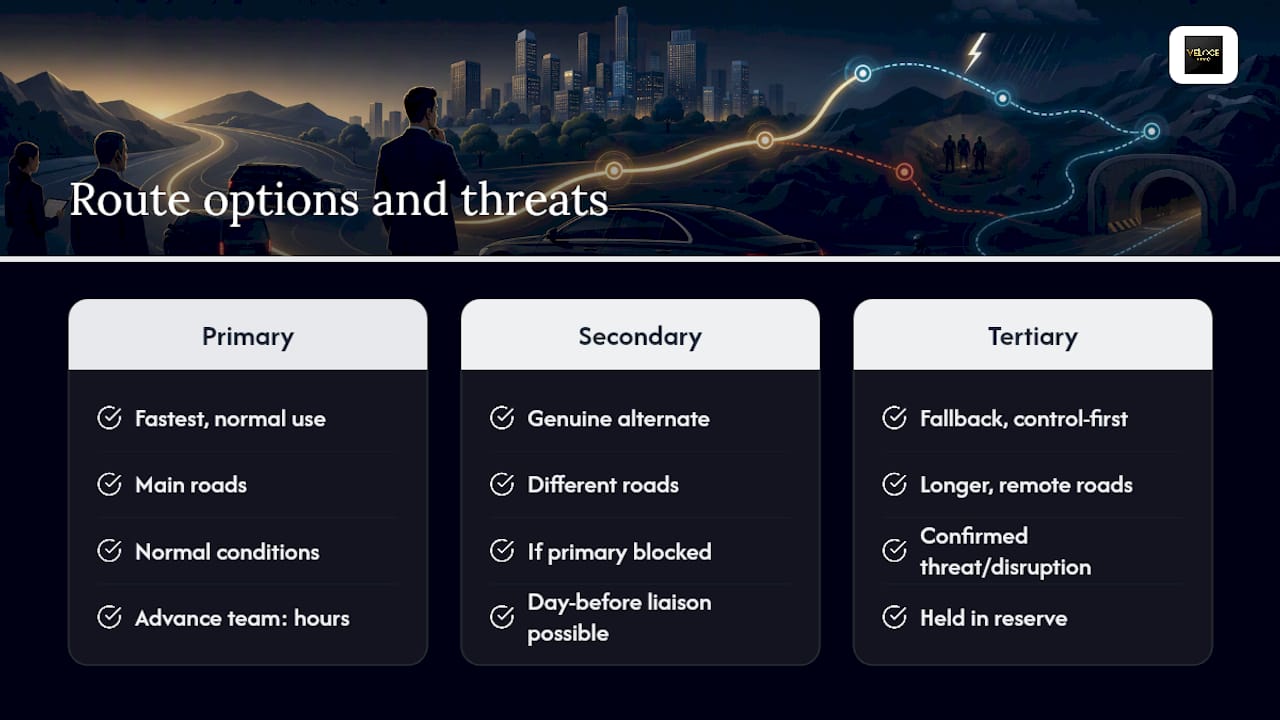
Primary route: the fastest, lowest-friction path, used under normal conditions and confirmed by the advance team within hours of the movement.
Secondary route: a genuine alternate, not a minor variation, ideally using different roads entirely rather than a parallel street that funnels back into the same choke point.
Tertiary route: a fallback held in reserve for confirmed threat indicators or major disruption, often longer but chosen for control rather than speed.
Threat scoring against each route should weigh predictable stopping points (traffic lights, level crossings, single-lane bridges), venue exposure at drop-off, and how visible the principal is during transfer between vehicle and building. Staging matters just as much as the drive itself: where the vehicle waits, how long it idles, and who has line of sight to it while it does. Decoy or curtain vehicles are a legitimate tool here, not theatre, and one useful piece of guidance on discreet transport notes that visible redundancy can protect a principal while preserving a normal-looking client experience rather than turning the movement into an obvious security operation.
Requesting an official escort depends entirely on tier and jurisdiction. For tier-one movements involving recognised dignitaries, police liaison is typically arranged through a protocol office well in advance, often with a lead time measured in days rather than hours, and requires documentation confirming the visit’s official status. For tier-two corporate movements, a private security liaison with local police non-emergency lines, arranged the day before, is usually sufficient. Never assume an escort can be requested same-day; most authorities need advance paperwork to allocate resources.
Pro Tip: Run the advance team’s reconnaissance at the same time of day the actual movement will happen, not the day before at a convenient hour. Traffic patterns, school run timing and event crowds shift by the hour, and a route that looked clear at 10am can be a bottleneck at 5pm.
Communications protocol and data privacy
A VIP transport protocol lives or dies on who knows what, and when. Restricted-manifest design is the single most effective control here: complete itineraries stay limited to the protocol lead and transport coordinator, while chauffeurs and support staff receive only the pickup point, drop point, and timing they need to do their job. This need-to-know structure reduces both deliberate leaks and the far more common accidental exposure, a document forwarded to the wrong list, a detail mentioned within earshot of the wrong person.
Communications channels should be fixed before the movement begins:
One authorised messaging channel, ideally encrypted, used exclusively for movement-related communication.
A single point of contact per role, so instructions never arrive from two directions at once.
Standard message templates for status updates (“en route”, “arrived”, “delayed 10 minutes”) that avoid naming the principal directly.
A clear no-photography, no-social-media policy for all staff with access to the manifest, signed as part of onboarding.
Secure transport guidance consistently recommends encrypted channels and a single authorised point of contact specifically to reduce leak risk, and this holds whether the movement is a head-of-state visit or a corporate board member’s airport run. Hotel-sector VIP handling procedures apply the identical logic to guest data, restricting itinerary access to staff who directly need it for pre-arrival preparation.
If a leak does occur, whether a location detail posted online or a manifest forwarded outside its authorised list, the response needs to be immediate: confirm what was exposed, assess whether the route or staging plan needs to change, and notify the protocol lead before continuing the movement. A protocol that has no defined leak response is one that assumes leaks never happen, which is not a safe assumption to build a plan on.
Vehicle selection, inspection and fleet readiness
Vehicle choice should follow the tiering decision, not the other way round. A tier-one movement might call for an armoured or reinforced sedan with a chase vehicle; a tier-three corporate movement is usually well served by a clean, late-model executive sedan or MPV, provided it is properly inspected and the chauffeur is briefed to standard.
Matching vehicle type to mission looks roughly like this:
Sedans for single-principal or two-passenger movements requiring a lower profile.
MPVs and luxury vans for principal-plus-team movements, or when luggage and equipment need to travel with the group.
Coaches for VIP delegations travelling as a group, common in official visits and large corporate events.
Every vehicle assigned to a VIP movement needs a pre-shift inspection covering fuel level, tyre condition, fluid levels, interior cleanliness, and a functional test of communications equipment fitted in the vehicle. A backup vehicle policy should be standard for any tier-two-or-above movement: a second vehicle staged nearby, ready to substitute within minutes if the primary develops a fault. Equipment carried should include a charged communications device separate from the chauffeur’s personal phone, a basic medical kit, and spare essentials such as an umbrella, bottled water and phone chargers, none of which sound critical until the moment they are needed.
Contingency planning and incident response
Every VIP transport protocol needs a written response for the incidents that are statistically most likely to happen, because working it out in real time is how small problems become visible failures. Four playbook types cover most scenarios:
Mechanical failure: Backup vehicle deploys immediately from its staging point; chauffeur relays exact location over the authorised channel; principal is moved to the backup with minimal delay rather than waiting for the original vehicle to be repaired roadside.
Medical incident: Chauffeur applies first aid training immediately, transport coordinator contacts emergency services and the protocol lead simultaneously, and the movement is suspended until medical clearance is given.
Security incident: Movement diverts to the pre-agreed tertiary route without discussion, security lead takes command of communications, and the advance team is alerted to clear the destination or arrange an alternate.
Media or leak incident: Protocol lead assesses exposure immediately, confirms with the host whether to continue or reroute, and documents exactly what was exposed and how, for the post-movement report.
The escalation chain should never have more than two steps between the person who spots the problem and the person authorised to make the call. Evidence preservation matters more than people expect: timestamps, photos of any vehicle damage, and a written note of exactly what was said over the communications channel all become important if an incident needs formal review afterwards.
Deciding when to suspend movement entirely, rather than push through, comes down to one test: does continuing increase risk to the principal beyond what stopping would cost in delay? If yes, stop. An emergency extraction, moving the principal out through an unplanned route or exit, should only ever be a last resort, and every advance team member should know the nearest safe extraction point before the movement begins, not discover it under pressure.
Pro Tip: Run a short tabletop exercise before any tier-one movement, walking the team through one mechanical and one security scenario out loud. It takes fifteen minutes and reliably exposes gaps that a written playbook alone never catches.
Execution-day checklist and timing buffers
Everything built in planning gets tested on the day itself, and this is where hold times and buffer windows earn their place in the protocol. A hold time is the deliberate pause built into a schedule to absorb small delays without cascading them into the rest of the day; a buffer window is the margin added between movements to allow for exactly that kind of slippage.
Staging window opens: Vehicle and chauffeur arrive at the staging point at least 30 minutes before the scheduled pickup, allowing time for the final inspection and a communications check.
Call-time confirmed: Transport coordinator confirms with the host that the principal’s schedule has not shifted, and relays any change immediately to the chauffeur.
Green-light check: Advance team confirms the destination is clear and staging is ready; only then does the vehicle move from its staging point.
Movement executes: Chauffeur follows the confirmed primary route, providing status updates at agreed intervals using the approved message templates.
Hold time applied if needed: If the principal runs early or late, the vehicle holds at a pre-identified safe point rather than idling visibly at the destination.
Handover: On arrival, the chauffeur confirms drop-off with the transport coordinator and documents the exact time, closing that leg of the movement.
Documentation to carry throughout the day should include the printed or digital route plan, emergency contact list, and any venue access passes gathered during planning. The final handover is not just a formality: it is the point where responsibility for the principal’s safety formally passes from the transport team to the venue or the next leg’s team, and it should be confirmed verbally, not assumed.
Post-movement debrief and reporting
The movement is not finished when the principal steps out of the vehicle. A short debrief, ideally within an hour, captures what worked and what did not while it is still fresh. This should stay confidential to the protocol lead and transport coordinator, particularly if anything sensitive occurred during the movement.
Quality metrics worth capturing every time include:
Punctuality against the planned schedule, including any hold times used.
Any incidents, however minor, and how they were resolved.
Any manifest or communications breaches, however small.
Chauffeur and vehicle performance against the pre-shift checklist.
Hotel-sector VIP guest management provides a useful reference point for what good response benchmarks look like in practice, citing gates such as minor requests handled within five minutes as a standard worth measuring against. Applying a similarly concrete timing benchmark to transport, such as how quickly a delay was communicated or a backup vehicle deployed, turns a vague sense of “it went fine” into something the protocol can actually improve against.
Every debrief should feed back into the written SOP. If a route consistently runs into unexpected congestion, it gets reclassified from primary to secondary. If a chauffeur briefing template missed a detail that caused confusion, the template gets updated before the next movement. A protocol that never changes after a debrief is not being taken seriously.
How Velocelimo builds these protocols into daily operations
Velocelimo runs scheduled, pre-arranged chauffeur bookings across sedans, MPVs, luxury vehicles and coaches, which maps directly onto the tiering model described above: the right vehicle class assigned to the right level of movement, confirmed in advance rather than hailed on demand. Pre-arrival checks, transparent pricing and professional chauffeur standards are built into every booking, whether it is a single airport transfer or coordinated event transport for a delegation.
Corporate and event transport experience means fleet readiness and staff briefing are already standard practice ahead of group and executive movements, not something assembled ad hoc for a one-off request. That consistency is what a protocol is actually trying to protect.
Discretion versus visibility: the trade-off planners underestimate
The instinct in VIP transport planning is to treat discretion and service quality as opposites, and that is the wrong frame. Two rules cut through most of the confusion. First, apply least-privilege information by default: nobody on the team needs to know more than their role requires, and that includes the principal’s own staff, who leak details more often than outside parties do. Second, build fail-safe routing into every plan, not just tier-one ones, because the movement that never needs its alternate route is cheap insurance, and the one that does will justify the whole exercise in a single afternoon.
Where a movement carries real risk, whether reputational, political or physical, hand it to a provider with actual protocol discipline rather than treating it as a booking problem. And before the day matters, run it once when it does not: a short dry run with the chauffeur and advance team exposes staging gaps and comms weak points far more cheaply than discovering them live.
— Yeniece
Book a chauffeur that already runs to protocol
Every element covered here, tiering, pre-arrival checks, restricted briefings, fleet readiness, is already how Velocelimo operates day to day, not a special mode switched on for VIP bookings. That is the practical advantage over assembling a one-off arrangement through a general private-hire app: the protocol discipline already exists in the standard airport transfer and hourly chauffeur services, so nothing has to be improvised for a sensitive movement.

Airport transfers, hourly chauffeur bookings and full event transport for delegations all draw on the same fleet of modern sedans, MPVs, luxury vehicles and coaches, booked in advance with transparent, all-inclusive pricing rather than surge rates or last-minute uncertainty. If your organisation needs a protocol briefing or a corporate quote for a sensitive movement, book online or get in touch to talk through your tiering and route requirements before the date is fixed.
Sources
FAQ
What is a secure transport protocol used for?
A secure transport protocol is used to move a VIP from one point to another while controlling who has access to itinerary details, which route is taken, and how communications about the movement are handled, reducing both physical and privacy risk.
What does VIP security mean in a transport context?
VIP security in transport means the combination of vetted chauffeurs, planned and alternate routes, restricted manifests and a contingency plan, all scaled to the principal’s tier rather than applied uniformly to every movement.
How does VIP transport actually work day to day?
It runs on a fixed sequence: tiering the movement, planning against timed checkpoints from days out to minutes out, briefing staff on a need-to-know basis, and executing with hold times and buffer windows built in to absorb delays without cascading them.
What are the main benefits of a formal VIP transport protocol?
The main benefits are fewer timing failures, reduced leak risk through restricted manifests, and a documented response ready for mechanical, medical or security incidents rather than improvised reactions under pressure. Velocelimo builds these standards into its scheduled corporate and event bookings as a matter of course.
Do smaller organisations need a full VIP transport protocol?
Not the full tier-one version, but even a tier-three elevated protocol, vetted chauffeurs, a basic route plan and a restricted manifest, meaningfully reduces risk for executive or reputationally sensitive travel without the overhead of a full security detail.
Meta title: VIP Transport Protocol: The Complete Operational Guide
Meta description: Learn what a VIP transport protocol must deliver: tiering, secure routes, vetted chauffeurs and contingency plans, built for planners who need results.
Suggested internal links:
Anchor text “event transport for a delegation” → https://www.velocelimo.com/post/vip-event-transport-services-in-singapore
Anchor text “hourly chauffeur” → https://www.velocelimo.com/corporate-hourly-chauffeur-service-singapore
Anchor text “airport transfer” → https://www.velocelimo.com/service-page/singapore-airport-transfer
Suggested URL slug: /vip-transport-protocol-guide
Recommended
Comments