
Role of vehicle type in group travel: a planner's guide
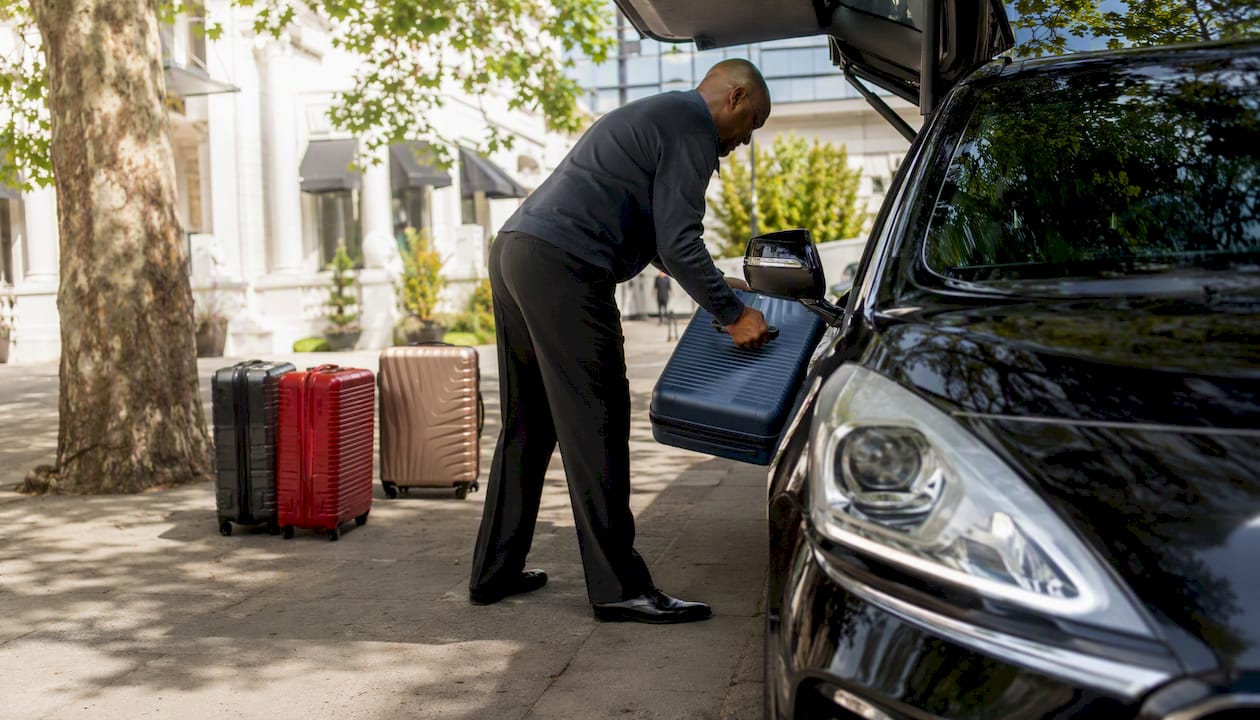
The best vehicle for a group trip is the smallest single vehicle that comfortably fits all passengers, luggage and access needs while meeting UK driver and licensing requirements. Get that decision right and you reduce cost per passenger, simplify coordination, and lower emissions in one move. Get it wrong and you pay for empty seats, struggle with luggage, or face a compliance problem on the day.
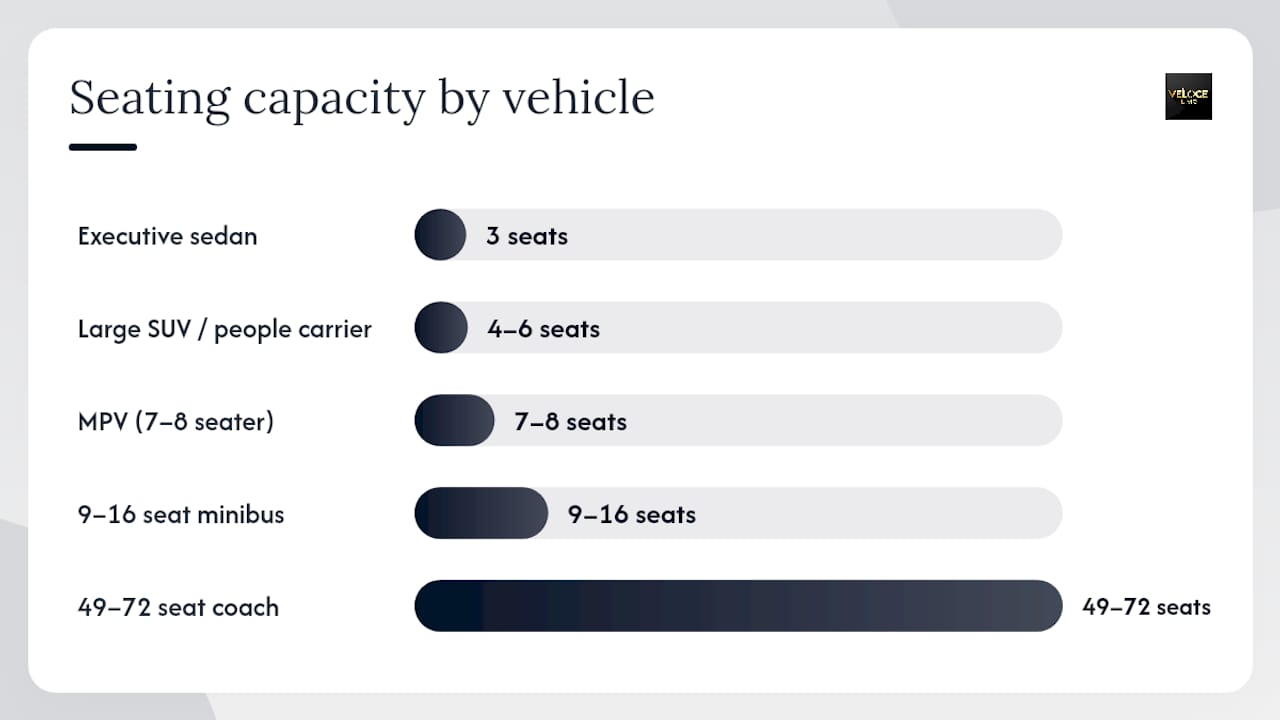
Group size | Recommended vehicle category |
1–3 passengers | Executive sedan / premium saloon |
4–6 passengers | Large SUV / people carrier |
7–12 passengers | MPV (7–8 seat) or 9–16 seat minibus |
13–36 passengers | 24–36 seat minibus |
37+ passengers | 49–72 seat coach |
The four trade-offs that shape every vehicle choice:
Cost per passenger falls sharply as occupancy rises, but only if the vehicle is genuinely full.
Luggage capacity is often the binding constraint, not seat count, particularly for airport transfers.
Manoeuvrability limits where larger vehicles can collect and drop off, adding non-revenue time.
Onboard facilities (reclining seats, WC, air-con) become non-negotiable beyond roughly two hours of travel.
Table of Contents
How vehicle type shapes every group travel decision
The role of vehicle type in group travel goes well beyond headcount. Each category carries a distinct set of operational characteristics that affect comfort, cost, compliance and the practicality of your route.
Executive sedan / premium saloon seats 3 passengers with luggage. It suits VIP airport transfers, corporate one-to-ones and small executive delegations where presentation matters. Parking is straightforward, and no special licence is required beyond a standard Category B entitlement.
Large SUV / people carrier handles 4–6 passengers with moderate luggage. SUVs offer better manoeuvrability and a premium feel for city transfers, making them the natural choice for small corporate teams or families travelling together. The boot space is generous but not unlimited; two large suitcases per passenger is typically the ceiling.
MPV / 7–8 seater is the workhorse of small-group travel. It carries 7–8 passengers with cabin luggage or 5–6 with full-size bags. Airport shuttles, wedding parties and small tour groups all fit this category well. A standard Category B licence covers most 8-seat MPVs in the UK.
9–16 seat minibus (including 13-seater Hiace-style) bridges the gap between people carriers and full minibuses. Sprinter-style vans seat roughly 14–18 passengers and suit short, flexible urban runs and airport shuttles where a full coach would be impractical. UK drivers operating a minibus for hire or reward above 8 passenger seats require a D1 entitlement or full PCV (Category D) licence.
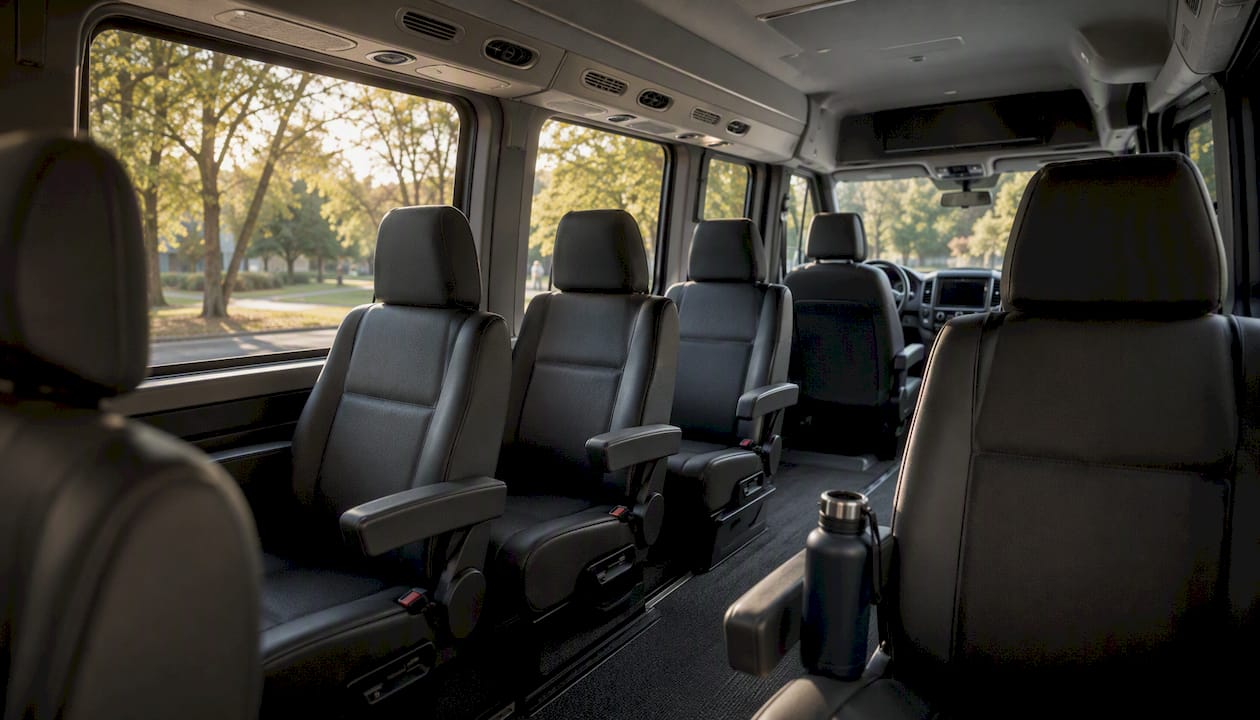
24–36 seat minibus suits medium-sized corporate groups, school trips and wedding shuttles between venues. Underfloor luggage space is limited compared with a full coach, so this category works best for day trips with hand luggage rather than multi-day tours.
49–72 seat coach delivers the lowest per-passenger cost for large groups and the best long-distance comfort: reclining seats, onboard WC, air-conditioning and substantial underfloor luggage bays. Coaches require a Category D licence and the operator must hold a Public Service Vehicle (PSV) operator licence.
Vehicle category | Seats | Luggage capacity | Onboard amenities | Accessibility | Manoeuvrability | Licence required |
Executive sedan | 3 | 2–3 large cases | Climate control | Standard | Excellent | Category B |
Large SUV / people carrier | 4–6 | 4–6 large cases | Climate control | Standard | Good | Category B |
MPV / 7–8 seater | 7–8 | 5–7 cases | Climate control | Standard | Good | Category B (≤8 seats) |
9–16 seat minibus | 9–16 | Roof/van floor | Climate control | Ramp optional | Moderate | D1 or D (hire/reward) |
24–36 seat minibus | 24–36 | Limited underfloor | A/C, basic seating | Ramp optional | Restricted | D |
49–72 seat coach | 49–72 | Large underfloor bays | Reclining seats, WC, A/C | Lift optional | Restricted | D + PSV operator licence |
How does vehicle choice affect cost per passenger and emissions?
Per-passenger cost has two components: the fixed hire cost of the vehicle and driver, and the variable costs of fuel, parking and airport concession fees. The fixed element dominates. A 16-seat minibus hired for a 45-minute airport transfer costs roughly the same whether it carries 4 passengers or 14. Fill it, and the per-person figure drops dramatically. For example, a 7-seater MPV for a group typically costs less per person as occupancy increases, and larger vehicles similarly show lower per-person costs when more passengers fill the seats. The exact prices vary with location, vehicle, and booking details.
A charter coach typically becomes cheaper per person than multiple small vehicles once the group reaches roughly 15–20 passengers, and the coordination overhead of managing several separate vehicles adds both cost and arrival spread.
The environmental picture follows the same logic. Research from the UCL Energy Institute finds that occupancy alone explains approximately 70–90% of the variation in energy and greenhouse gas intensity across passenger transport modes. A half-empty coach is not automatically greener than a full minibus.
Key finding: According to MDPI’s Sustainability journal, emission factors vary by vehicle type, occupancy, technology and operating conditions. Planners should select emission factors that match their specific case rather than rely on generic averages, particularly when comparing hybrid or electric options against conventional diesel vehicles.
Hybrid powertrains add nuance. Real-world driving cycle research shows hybrid vehicles can achieve fuel savings of around 39% compared with conventional petrol equivalents in some conditions, but may produce higher CO or HC emissions under certain real-world cycles. The headline CO₂ saving is real; the full picture requires checking the specific vehicle and route profile.
Which vehicle suits your trip type?
Airport transfers
Prioritise luggage space and reliable flight tracking above all else. An MPV or 7–8 seater handles small corporate teams of up to 6 with full-size bags comfortably. For 7–16 passengers, a sprinter-style minibus gives the luggage floor space that a people carrier cannot. Groups above 20 should move straight to a coach, where underfloor bays absorb checked luggage without compromise.
Booking tip: Confirm the operator monitors live flight data and has a clear policy for delays. A fixed-price airport transfer with flight tracking removes the risk of waiting charges when arrivals run late.
Day tours and multi-stop itineraries
Multiple stops change the calculus. A single larger vehicle keeps the group together and eliminates the coordination cost of convoy driving, but a coach cannot always access narrow village roads or private car parks. For groups of 10–20, two MPVs or a 16-seat minibus often gives better flexibility than one large coach. Group tour planning guides consistently highlight rest stops and driver waiting charges as the two costs planners underestimate most.
Booking tip: For van or minibus trips under 90 minutes, schedule at least one rest stop to manage driver hours and passenger comfort. Confirm waiting-time charges before departure.
Long-distance travel (2+ hours)
Coaches win on journeys beyond two to three hours. Reclining seats, an onboard WC and underfloor luggage bays make a material difference to passenger experience on runs between cities. Sprinter vans suit short airport runs; coaches suit long-distance travel where comfort and luggage capacity are the primary concerns. Single-vehicle cohesion also matters: keeping the group together avoids the arrival-spread problem that plagues multi-vehicle convoys.
Booking tip: For coach journeys over three hours, ask the operator to confirm rest stop locations and whether the driver is operating under tachograph rules, which affect maximum driving hours.
What do accessibility and luggage planning require?
Wheelchair access
Not all minibuses and coaches offer step-free access. Vehicles with a tail lift or fold-out ramp are available across the 9–16 seat and coach categories, but they must be requested explicitly at booking. Confirm the maximum wheelchair width the ramp accommodates (typically 700–750mm for most UK-spec vehicles), the weight limit for the lift, and the number of securement points inside the vehicle.
Child seats and booster rules
Under UK law, children must use a child car seat until they are 12 years old or 135cm tall, whichever comes first. This applies in private hire vehicles. Most operators do not carry child seats as standard equipment; you must request them in advance and confirm they meet current UK standards (UN Regulation 44 or the newer i-Size/UN Regulation 129). Never assume the operator will supply them without written confirmation.
Luggage planning checklist
Allow one large suitcase and one piece of hand luggage per passenger as the baseline estimate.
For coaches, underfloor bays typically hold 1.5–2 cubic metres per bay; confirm total bay volume with the operator.
For minibuses, luggage goes in the van floor space or a rear compartment; this competes directly with passenger seating if the vehicle is full.
Sporting equipment, pushchairs and oversized items need individual confirmation, not a general assurance.
Pro Tip: If your group includes a wheelchair user, book that vehicle first and build the rest of the fleet around it. Mixing a wheelchair-accessible minibus with standard sedans for the remainder of the group is operationally cleaner than trying to retrofit access into a vehicle that was not specified for it.
What UK licensing and insurance rules must you check before booking?
The licensing threshold that catches most planners out: any vehicle with more than 8 passenger seats used for hire or reward requires the driver to hold a D1 (minibus, 9–17 seats) or Category D (bus/coach, 17+ seats) entitlement, and the operator must hold a PSV operator licence issued by the Traffic Commissioner. A driver holding only a standard Category B car licence cannot legally carry fare-paying passengers in a 9-seat minibus, regardless of how the booking is framed.
Driver hours rules under the EU-derived retained legislation (now part of UK domestic law) apply to most commercial passenger-carrying operations. Coaches and larger minibuses operating commercially are subject to tachograph requirements; drivers cannot exceed 9 hours of driving per day (extendable to 10 hours twice a week) and must take a 45-minute break after 4.5 hours of driving. For day tours, this directly affects your itinerary.
On insurance, ask every operator for written confirmation of:
Commercial passenger liability insurance (not just private motor insurance).
Current MOT and roadworthiness certification for the specific vehicle.
Operator licence number (verifiable on the GOV.UK operator licence register).
Named driver entitlements matching the vehicle category.
Red flags to avoid: An operator who cannot provide their PSV operator licence number on request, quotes a price significantly below market rate without explanation, or is vague about the specific vehicle and driver assigned to your booking is a compliance risk. Late cancellations, uninsured vehicles and unlicensed drivers are the three most common causes of group transport failures on the day — and all three are preventable with a five-minute pre-booking check.
For full GOV.UK guidance on PCV licensing and operator requirements, visit gov.uk/become-a-bus-or-coach-operator and gov.uk/driving-licence-categories.
How do you calculate the right vehicle size for your group?
Apply these rules of thumb first, then adjust for luggage and access.
Passenger-to-vehicle assignment:
1–3 passengers: executive sedan.
4–6 passengers: large SUV or people carrier.
7–12 passengers: MPV or 9–16 seat minibus.
13–36 passengers: 24–36 seat minibus.
37+ passengers: 49–72 seat coach.
Simple sizing formula:
Required seats = passenger count + 10% buffer (round up to the next vehicle category).
Luggage bays needed = (passenger count × average bags per person) × 0.9 to allow for underfloor allocation.
Worked examples:
Group size | Passengers + buffer | Luggage estimate | Vehicle pick |
5 colleagues, airport transfer | 5 + 1 = 6 seats | 5 large cases | Large SUV / people carrier |
— | — | Hand luggage only | 13–16 seat minibus |
— | — | — | 49-seat coach |
Splitting into multiple vehicles is sometimes the right answer, particularly when the group has mixed pickup points or when a single large vehicle cannot access a venue. The coordination cost is real: two vehicles arriving at different times, drivers needing separate briefings, and passengers splitting across vehicles all add friction. For groups of 10 or more, a single hired vehicle is usually cheaper per person and easier to coordinate than multiple smaller alternatives. Accept the split only when the route or access genuinely requires it.
What should you confirm with the operator before booking?
Run through this checklist before confirming any group hire.
Vehicle and capacity:
Exact vehicle make, model and year of registration.
Confirmed seating capacity and luggage bay volume for your specific group.
Accessibility features: ramp/lift availability, securement points, step height.
Child seat availability and confirmation of current UK standard compliance.
Driver and compliance:
Driver licence category (D1 or D for vehicles above 8 seats used for hire or reward).
PSV operator licence number.
Commercial passenger liability insurance confirmation in writing.
Tachograph compliance and driver hours policy for long journeys.
Operational details:
Exact pickup and drop-off points, including any access restrictions.
Flight tracking policy for airport transfers.
Contingency plan for vehicle breakdown or driver unavailability.
Rest stop arrangements for journeys over 90 minutes.
Waiting-time charges and the grace period included in the quote.
Pricing clarity:
Ask directly: “Does this price include parking, airport concession fees and fuel surcharges, or are those added separately?” A fixed all-in quote eliminates invoice surprises. Confirm the cancellation policy and any amendment fees in writing before paying a deposit.
Pre-booking is increasingly the norm for group transport. Structured single-vehicle solutions produce significant per-person savings through cost sharing, and locking in a vehicle early gives you leverage to confirm all the above details without time pressure.
Key takeaways
Choosing the right vehicle for a group trip comes down to one principle: match the smallest single vehicle that fits passengers, luggage and access needs to the trip type, then verify the operator’s licence and insurance before confirming.
Point | Details |
Size to the smallest single vehicle | Match passenger count plus a 10% buffer to the appropriate category; avoid paying for empty seats. |
Luggage often decides the category | Confirm bay volume in writing; luggage constraints regularly push groups into the next vehicle size up. |
Occupancy drives emissions and cost | UCL research shows occupancy explains approximately 70–90% of the variation in energy and greenhouse gas intensity across passenger transport modes; a full vehicle is always greener and cheaper per person. |
Verify licence and insurance | Operators running vehicles above 8 seats for hire or reward need D1/D entitlement and a PSV operator licence; check both before booking. |
Velocelimo for pre-booked group transfers | Velocelimo offers fixed-price group and family transfers with professional chauffeurs and a modern fleet including MPVs and 13-seater coaches. |
A planner’s honest view on group transport decisions
The detail most planners overlook is non-revenue driver time. A vehicle quoted at an hourly rate is accumulating cost from the moment the driver leaves the depot, not from the moment passengers board. On a city-centre pickup with a 30-minute staging requirement, an hourly rate can add £40–£60 to the apparent quote before the journey even starts. Fixed point-to-point pricing removes that ambiguity entirely, which is why experienced planners increasingly prefer it for airport transfers and venue shuttles.
The other judgement call that trips people up: when to accept multiple vehicles. The instinct is to resist splitting the group because it feels disorganised. Sometimes that instinct is right, particularly for corporate delegations where cohesion signals professionalism. But for multi-stop day tours where different passengers have different endpoints, two smaller vehicles with flexible routing can outperform one large coach that has to complete a fixed loop. The decision should be driven by the route, not by a preference for simplicity.
On hybrid and electric options: the CO₂ savings are real, but these vehicles require different operational planning. Charging infrastructure, range limits and depot access all affect whether a hybrid or electric minibus is genuinely suitable for a day tour with multiple stops. Ask the operator specifically whether the vehicle can complete your full itinerary on a single charge or tank, and what the contingency is if it cannot.
Velocelimo operates a modern fleet of sedans, MPVs and 13-seater coaches with professional chauffeurs and fixed-price transfers, which is the operational model this article consistently points to as the lower-risk choice for planners who need reliability over the cheapest headline rate.
Useful sources and further reading
A holistic analysis of passenger travel energy and greenhouse gas intensities (UCL Energy Institute)
Choosing emission factors for transport applications (Sustainability, MDPI)
Charter bus vs sprinter van: a practical guide for group travel (All Star Shuttles)
Charter bus vs alternatives: group transport comparison (BusBrother)
SUV vs minibus for group travel: choosing the best fit (Empire Limo Transfer)
Group transportation behaviour study (2026)
Velocelimo: professional group transfers, fixed pricing, no surprises
Planning group transport in Singapore? Velocelimo offers pre-booked chauffeur transfers for groups of all sizes, from executive sedan runs for small corporate teams to 13-seater coach transfers for larger parties. Every booking comes with a professional, licensed chauffeur, a modern and well-maintained vehicle, and transparent fixed pricing that covers the full journey, with no hidden waiting charges or fuel surcharges added at the end.

For airport transfers, Velocelimo includes real-time flight tracking as standard, so your driver adjusts to actual arrival times rather than scheduled ones. That single feature eliminates the most common source of stress on group airport pickups. For families, wedding parties and corporate groups, the family and group travel service covers point-to-point transfers with the same fixed-price model.
Book your group transfer online and confirm vehicle type, capacity and pricing in one step.
FAQ
What vehicle types are used for group travel in the UK?
The main categories are executive sedans (up to 3 passengers), large SUVs and people carriers (4–6), MPVs and 7–8 seaters, 9–16 seat minibuses, 24–36 seat minibuses, and 49–72 seat coaches. The right choice depends on passenger count, luggage volume, trip length and accessibility requirements.
When does a driver need a special licence for group hire in the UK?
Any vehicle with more than 8 passenger seats used for hire or reward requires the driver to hold a D1 entitlement (9–17 seats) or Category D licence (17+ seats), plus the operator must hold a PSV operator licence. A standard Category B car licence is not sufficient for commercial minibus or coach operations.
What is the difference between a minibus and a coach for group travel?
A minibus typically seats 9–36 passengers with limited underfloor luggage space and suits shorter urban or regional trips. A coach seats 37–72 passengers, offers substantial underfloor luggage bays, reclining seats and an onboard WC, and becomes the more comfortable and cost-efficient option for journeys beyond two to three hours.
How does vehicle occupancy affect emissions and cost per passenger?
Research from the UCL Energy Institute shows that occupancy explains approximately 70–90% of the variation in energy and greenhouse gas intensity across passenger transport modes. A full vehicle of any category produces significantly lower emissions and cost per person than a half-empty one, which is why maximising occupancy is the single most effective lever for both sustainability and value.
Does Velocelimo offer group transfers with fixed pricing?
Yes. Velocelimo provides pre-booked group and family transfers in Singapore using a modern fleet that includes MPVs and 13-seater coaches, all with fixed all-in pricing and professional licensed chauffeurs. Airport transfers include real-time flight tracking as standard.
Meta title: Role of vehicle type in group travel: planner’s guide
Meta description: Understand the role of vehicle type in group travel with this UK-focused planner’s guide covering capacity, cost per passenger, licensing rules and sustainability evidence.
Suggested internal links:
Suggested URL slug: /role-of-vehicle-type-in-group-travel
Recommended
Comments